Befimmo Office Barometer 2026: Belgians want to return to the office
Befimmo Office Barometer 2026: Belgians want to return to the office
The second edition of the Befimmo Office Barometer, an annual survey by research agency iVOX among 1,000 Belgian employees and 200 students, confirms a strong return to the office across two generations at once. It is one of the clearest trends in this year's edition.
Key findings
- A third of employees (33%) never want to work from home again, up 8 percentage points on last year. Among students, the wish to come to the office every day (18%) rose by exactly the same margin.
- The wish to come every day to the office is far lower (13%) among employees without a fixed desk. Layout makes a measurable difference: in offices combining open and closed spaces, 64% say they can concentrate, against 33% in a flex-desk environment. Only 12% of workers currently work in such a combined environment.
- Physical contact remains essential: just 1% meet exclusively online, and 73% prefer a physical meeting for an important client conversation, rising to 81% among 18-to 34-year-olds.
- A quarter of employees (25%) book an external meeting room themselves or have the possibility to do it. The main barriers are cost (37%) and a booking process seen as too slow or complex (29%).
- Students remain enthusiastic about coworking: 69%, two years running. Among current employees, opinion is less pronounced this year.
- An additional survey among 50 Belgian HR directors and CFOs maps their view of AI's impact in the workplace.
The reasons why Belgians return to the office
Six in ten employees (59%) no longer have a fixed day for working from home in 2026, up from half last year. More than half (55%) never work from home at all, compared with 46% a year earlier, and even Friday, traditionally the most common home-working day, has fallen from 28% to 22%.
Students show the same pattern. Only 2.5% would now prefer to work from home full time, down from 8% last year, while those wanting to come in every day have climbed to 18%, exactly the same eight-point rise seen among the current workforce.
What draws people back is, above all, the work itself: collaboration and connection with colleagues (41%), access to better equipment (21%), and the ability to separate work from private life (19%).
The impact of office layout on concentration and productivity
Fewer employees feel their office layout supports creativity (26%, down 9 percentage points), teamwork (42%, down 5 points) or the ability to work quietly (32%, down 7 points) than a year ago.
Employees working in an environment that combines open and closed spaces score noticeably higher across the board than the average:
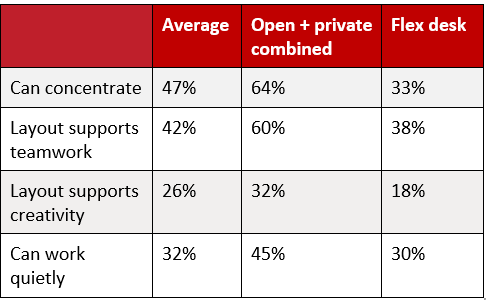
The reverse also holds: in an open space with flexible seating, half of respondents (51%) say noise and distraction affect their productivity, against 37% on average. Yet only 12% of Belgian office workers currently work in such a combined environment.
Employees and students are also moving in different directions on flexibility. This year, employees lean slightly more towards a fixed desk and slightly away from flex desks, while students show a little more openness to flexibility. For this incoming generation, expectations around accessibility and sustainability are also markedly higher: 77% of students consider good public transport access important, against 50% of current employees, and proximity to shops (43% versus 29%) and to food outlets (38% versus 27%) also weigh more heavily for them.
"Anyone designing tomorrow's office today would do well not to treat these two generations as one and the same." Jean-Philip Vroninks, CEO Befimmo
"Employees without a fixed workspace prefer to work part of the week from home. Only 13% of them want to come into the office every day, compared with 38% of those with a closed office. That makes sense: 38% of those with a flex desk say they cannot concentrate or carry out tasks effectively, against just 15% of those with a closed office. Nor do those with a flex desk feel their office layout supports teamwork. In other words, employers who want people back in the office more often would do well not to invest in a purely open landscape of flex desks." Stijn Baert, Labour Market Expert
In-person versus online meetings
A third of employees (35%) feel there are too many meetings, and those who take part in online meetings rate their own “digital fatigue” at 6.1 out of 10. Yet the finding is not that meetings are under pressure, but that routine online meetings are: only 1% of respondents meet exclusively online, against 32% who meet exclusively in person.
For an important conversation with a client or external partner, that preference is even more pronounced: 73% choose a physical meeting, rising to 81% among 18-to 34-year-olds. Physical client contact is also seen to strengthen the business relationship, rated 7.6 out of 10.
"The key is to be more selective when scheduling meetings. Nearly two in three office employees (63.5%) consider half or more of the meetings they attend to be unnecessary. And when meetings are useful, it's important to hold them under the right conditions: with an agenda and, ideally, in a dedicated, appealing physical space." Stijn Baert, Labour Market Expert
The expectations themselves are remarkably pragmatic: A quarter of employees (25%) book an external meeting room themselves, or know a colleague who does, mainly because internal space is lacking (37%) or because they want a central meeting point for geographically spread teams (33%). What holds others back is cost (37%) and a booking process seen as too slow or complex (29%). Those who do book tend to look for a mid-sized room for five to eight people (55%), with working basics such as an interactive screen (38%), simple wireless screen sharing (37%), on-site IT support (47%), coffee (44%) and catering in the room itself (36%).
Coworking is still popular with students
Among students, enthusiasm for coworking has held at around 69% for two years running, driven by a better atmosphere (55%), a more collaborative environment (36%) and access to relaxation spaces (33%).
Among current employees, opinion is less pronounced this year: 38% view coworking positively, 31% negatively, and almost a third (32%, up 6 points) have no strong opinion either way. French speakers, younger employees and those with higher education remain the most positive.
“A well-equipped meeting room, professionally staffed and centrally located, is exactly what today's businesses need: space, reliable technical equipment and a neutral setting where people can properly meet face to face.” Geoffroy Speybrouck, Managing Director, Silversquare
AI's impact on jobs
Befimmo also surveyed 50 Belgian HR directors and CFOs on the impact of artificial intelligence in the workplace. Asked to weigh two risks against each other, more respondents fear a loss of skills among staff who use AI structurally (32%) than job losses or role reductions (14%); a quarter (24%) see both risks as equally serious, and three in ten (30%) see little risk either way.
On AI's effect on employees' critical thinking, opinion is evenly split: 40% expect a negative impact, 40% a positive one, and 20% expect no impact at all. Of those expecting a negative impact, 70% say they are genuinely concerned. The skills most at risk, in their view, are critical and analytical thinking (52%), writing (48%) and problem-solving (48%). At the same time, close to half (46%) expect AI to reduce repetitive work, and 38% expect productivity gains.
Regarding employment, 38% expect a fall in the number of full-time roles over the next three years, against 48% who expect no change. Six in ten (60%) estimate that 1% to 20% of current roles will substantially change or disappear within five years because of AI, while a smaller group (16%) expects a bigger impact. Only 10% expect AI mainly to replace jobs outright; most see a shift in task content (30%) or a combination of both effects (32%). More than a third of respondents (36%) also fear that their own role could, in time, be partly or fully taken over by AI.
"Employees want to return to the office, and HR directors and CFOs mainly see AI as a chance to reduce routine work. But they are also clearly more concerned about skill loss than job loss, and more than a third even fear for their own role. That is a signal companies need to take seriously: organisations that embrace AI need to invest just as much in the people who work alongside it." Jean-Philip Vroninks, CEO Befimmo
Office Barometer 2026: Frequently Asked Questions
What is the Befimmo Office Barometer?
The Befimmo Office Barometer is an annual survey carried out by research agency iVOX between 3 and 13 July 2026, among 1,000 Belgian employees and 200 students, representative by gender, age and education level. The 2026 edition also includes an additional survey among 50 Belgian HR directors and CFOs, conducted between 19 and 26 August 2026.
What makes employees want to return to the office?
Collaboration and connection with colleagues top the list (41%), followed by access to better equipment (21%) and the ability to separate work from private life (19%).
What do employees expect from an external meeting room?
Room size comes first: 55% of respondents want a mid-sized space for five to eight people. Beyond capacity, five features stand out: on-site IT support (47%), coffee (44%), an interactive screen or digital whiteboard (38%), wireless screen sharing (37%), and catering (36%).
How does coworking sentiment compare between employees and students?
Students remain the most enthusiastic, at around 69% for two years running. Among current employees, opinion is more split: 38% view coworking positively, 31% negatively, and 32% have no strong opinion (up 6 points year-on-year).
How do HR directors and CFOs weigh AI's risk to jobs against the risk to skills?
Skills loss among staff who use AI structurally is the bigger concern (32%), ahead of job losses or role reductions (14%). A quarter (24%) see both risks as equally serious, and three in ten (30%) see little risk either way.
About the Office Barometer
The Office Barometer is an annual survey conducted by Befimmo. This year, the survey was carried out online by iVOX between 3 and 13 July 2026, among 1,000 working Belgians, representative by gender, age and level of education, as well as 200 students. The maximum margins of error are 3.02% and approximately 6.9% respectively, at a 95% confidence level. An additional online section was carried out between 19 and 26 August 2026, among 50 Belgian HR directors and CFOs.